A free editorial guide from riodejaneiro.app. Use it to build your itinerary; Rio Pulse’s personalised plans are still in development.
A replanted rainforest inside the city
Tijuca Forest and the Rio Botanical Garden: how to get there, what to see and which trails
Tijuca Forest is one of the largest urban forests in the world, and most of it was replanted by hand in the nineteenth century. Together with the Botanical Garden and Parque Lage below it, it gives Rio a green day that feels nothing like the beach. The catch is logistics: there is no metro, distances inside the park are longer than they look, and the best parts reward an early start.
Quick answer
Tijuca Forest is the Floresta sector of Tijuca National Park, entered through Praça Afonso Viseu in Alto da Boa Vista. No metro reaches it, so go by car, ride-hailing app or a guided tour. Easy highlights are Cascatinha Taunay, Capela Mayrink and the Vista Chinesa viewpoint; Pico da Tijuca is a proper hike. The Botanical Garden and Parque Lage sit lower down and combine well in one day.
From coffee farms back to rainforest
By the early nineteenth century the slopes above Rio had been cleared for coffee plantations and charcoal, and the city began to suffer from water shortages. In 1861 the imperial government ordered the land to be reforested. Major Manuel Gomes Archer led the work, largely carried out by enslaved labourers, planting tens of thousands of seedlings of native and exotic species. Later administrators, including the Baron of Escragnolle, continued the replanting and turned parts of the forest into landscaped grounds.
That history explains what you see today: a dense Atlantic rainforest that has grown back over more than a century and a half, threaded with old roads, fountains, bridges and viewpoints built in the imperial and early republican eras. The area became a national park in 1961 and is now managed by ICMBio, the federal conservation agency. It is divided into sectors: Floresta (the forest proper), Serra da Carioca, where Christ the Redeemer stands, and Pedra Bonita/Pedra da Gávea.
Getting there without a metro
No metro or train line reaches the forest. The main entrance to the Floresta sector is at Praça Afonso Viseu in Alto da Boa Vista, on the road that climbs between Tijuca in the northern zone and Barra da Tijuca. From Copacabana or Ipanema the most practical option is a ride-hailing app or taxi; the journey crosses mountain roads and traffic can make it much longer than the distance suggests. City buses pass through Alto da Boa Vista, but routes change, so check a live routing app before relying on one.
Inside the park, the attractions are spread along roads that wind through the forest, and walking between them all takes most of a day. A car, a hired driver or a guided tour makes it possible to see several points in one morning. Mobile signal can be weak in the valleys, so agree the pick-up time and place with your driver in advance rather than counting on calling a car from the middle of the forest. The getting-around guide covers app and taxi basics.
- Main forest entrance: Praça Afonso Viseu, Alto da Boa Vista.
- Best options: ride-hailing app, taxi, private driver or guided tour.
- Arrange your return before you lose signal inside the forest.
- Opening hours and road closures change: check the park’s official site.
Praça Afonso Viseu, Cascatinha and Capela Mayrink
The entrance at Praça Afonso Viseu is marked by a stone gateway, and the visitor centre nearby is the best place to confirm which trails and roads are open that day. A short drive or walk along the main road brings you to Cascatinha Taunay, a tall waterfall that drops over the rock face just off the road. It is named after the painter Nicolas-Antoine Taunay, who lived nearby. It is at its most impressive after rain, and it is the stop that almost every visitor makes.
Further in, Capela Mayrink is a small, white chapel in a clearing. Its altar panels were painted by Candido Portinari; the originals are now kept in a museum and the chapel shows reproductions, but the setting is still worth the stop. Beyond it, the road continues to picnic areas, the Açude da Solidão reservoir and trailheads. Park opening hours are set by the administration and can change, so check the current schedule on the park’s official website before you go.
- Cascatinha Taunay: roadside waterfall, strongest after rain.
- Capela Mayrink: small chapel with Portinari reproductions.
- Açude da Solidão: a quiet reservoir surrounded by forest.
Vista Chinesa and Mesa do Imperador
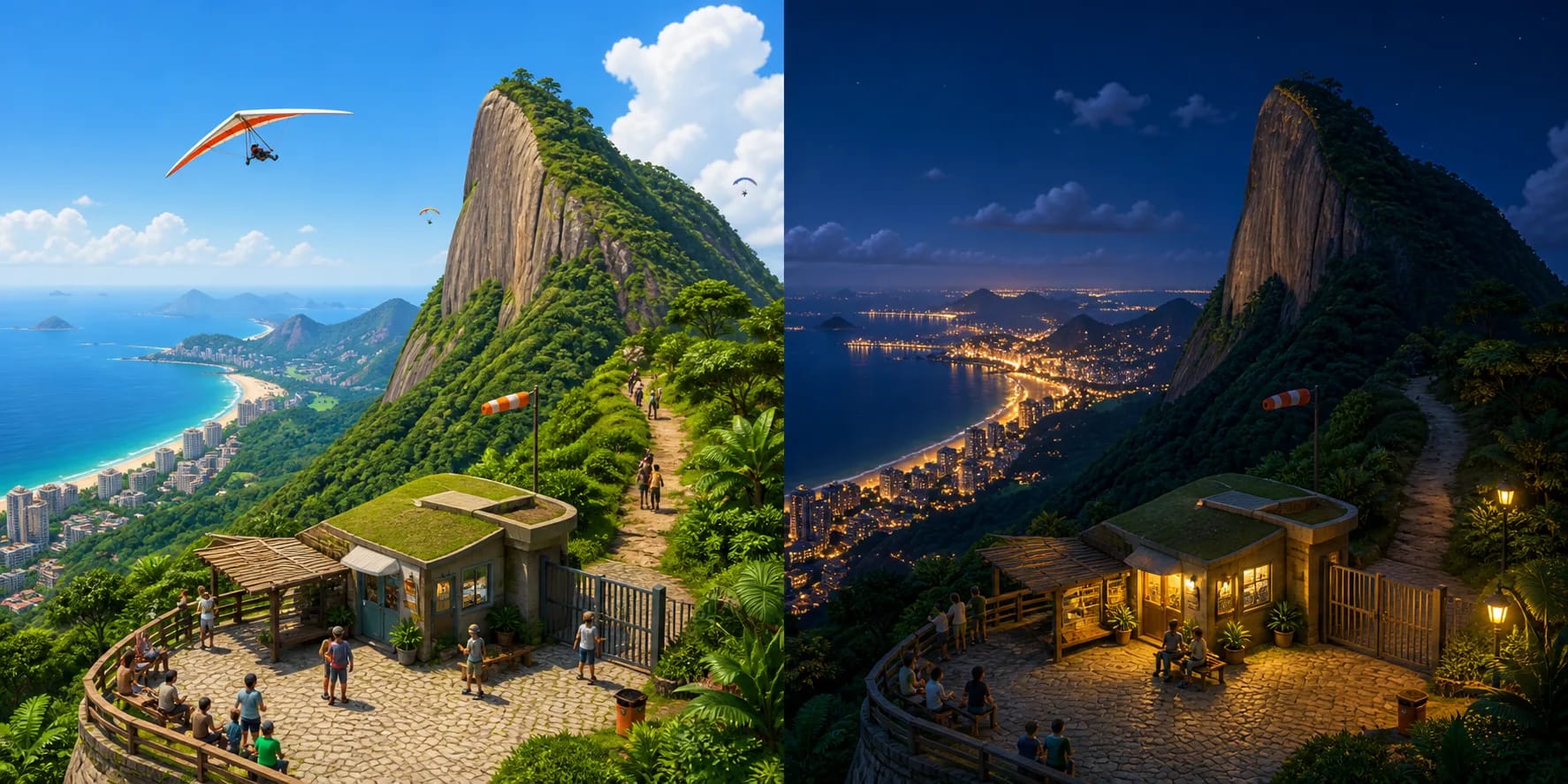
Vista Chinesa is a pavilion in the style of a Chinese pagoda, built in the early twentieth century on the road that climbs from the Botanical Garden side into the Serra da Carioca. From the balustrade you look down over the Lagoa Rodrigo de Freitas, Ipanema and Leblon, Sugarloaf and the bay. It is one of the best free viewpoints in Rio, and in the morning the light usually falls well on the view.
A little further along the same road, Mesa do Imperador is a stone table where, according to tradition, Emperor Pedro II held picnics. The view is broader and slightly different, taking in more of the southern zone. Both points are reached by road, not by trail, which makes them easy to include in a driving or tour route. Low cloud can cover both viewpoints even on a sunny beach day, so look up at the mountains before committing the time.
Easy walks versus serious trails
The Floresta sector has walks for every level. The easy end includes short paved or well-trodden paths around the Cascatinha, the Capela Mayrink and the reservoirs, which suit families and anyone who simply wants shade and birdsong. Signed paths to small waterfalls and grottoes add an hour or two without much climbing. Ask at the visitor centre which trails are open and marked, because conditions change after heavy rain.
Pico da Tijuca is a different proposition. At just over a thousand metres, it is one of the highest points in the city, and the trail climbs steadily through forest for several hours round trip, finishing on steps cut into the rock. The effort is real, the view from the top is wide on a clear day, and descending tired is when people slip. Start early, carry more water than you think you need, and read the hiking guide before choosing it.
- Easy: short paths around Cascatinha, Capela Mayrink and the reservoirs.
- Moderate: signed trails to small waterfalls and grottoes.
- Demanding: Pico da Tijuca, several hours with steep sections.
Jardim Botânico and Parque Lage
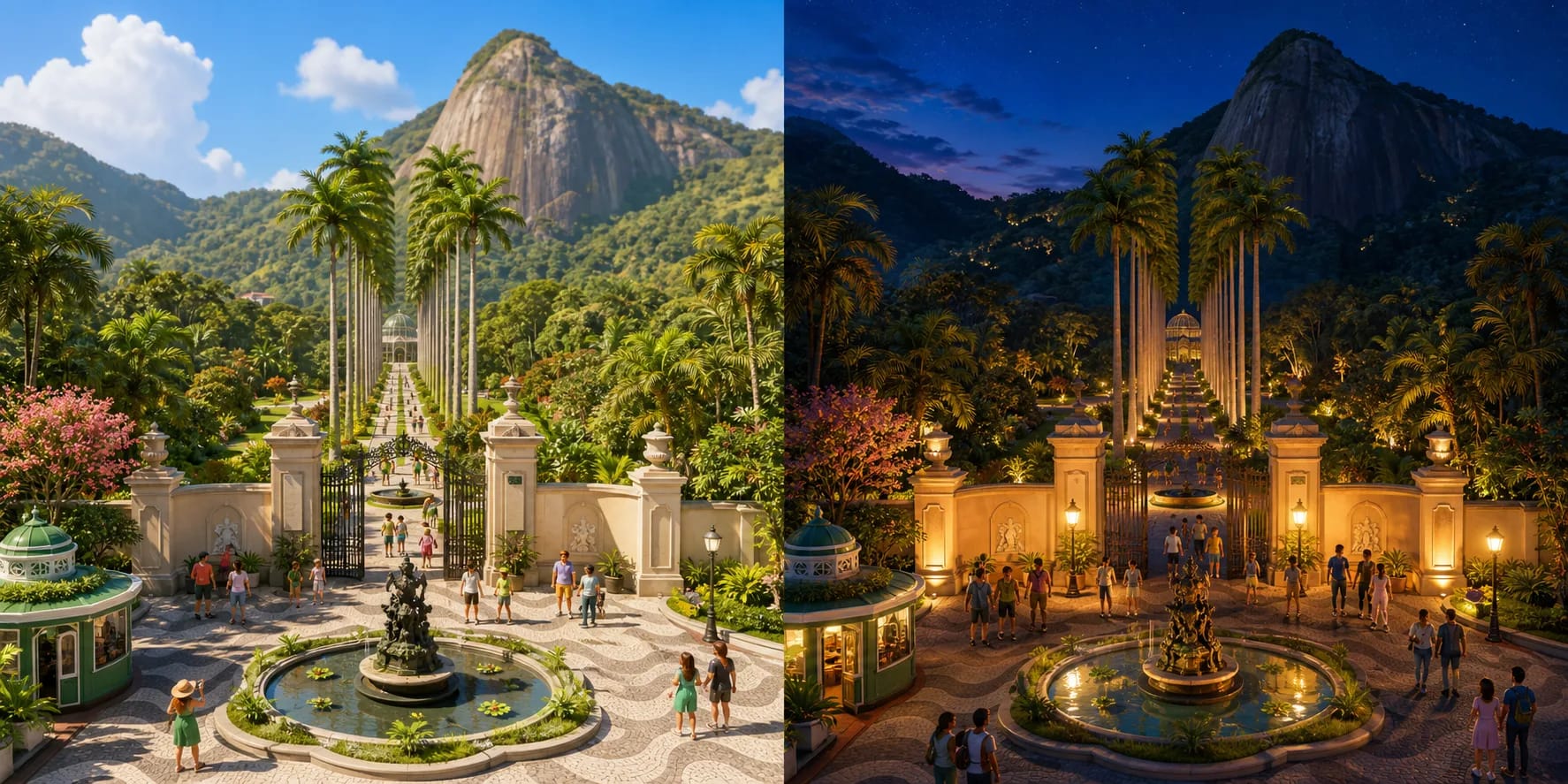
The Rio Botanical Garden was founded in 1808 by the Portuguese prince regent Dom João and is today a federal research institute as well as a public garden. Its best-known feature is the avenue of imperial palms, a long, straight line of very tall trunks that is Rio’s classic garden photograph. There is also an orchid house, a bromeliad collection, a Japanese garden, lakes with giant water lilies and plenty of shaded paths. Tickets, hours and guided visits are listed on the garden’s official website.
Parque Lage sits a short distance away, at the foot of Corcovado. Its early-twentieth-century mansion wraps around an inner courtyard with a pool, and it houses the Escola de Artes Visuais, a public art school. The grounds have forest paths, grottoes and a café, and they are also the start of the trail up to Christ the Redeemer. Both places work as a rainy-day fallback in light drizzle, although the paths get slippery.
- Avenue of imperial palms: the garden’s signature view.
- Orchid house, bromeliads and Japanese garden.
- Parque Lage: mansion courtyard, café and Corcovado trailhead.
One day, wildlife and going with others
A realistic one-day plan starts early in the Floresta sector, with the Cascatinha, the Capela Mayrink and a short walk, then drives down via Vista Chinesa and Mesa do Imperador to the Botanical Garden for the afternoon, ending with a coffee at Parque Lage. That leaves no room for Pico da Tijuca: a proper hike deserves its own morning. Families can shorten the forest part; see the Rio with kids guide for pacing.
Look out for capuchin monkeys, marmosets, coatis and a wide range of birds, including toucans; howler monkeys have been reintroduced to the forest in recent years. Do not feed any animal. On safety, the forest is not an isolated wilderness, but robberies have been reported on quieter roads and trails. Go in company, stay on busier routes, avoid late afternoons, and read the Rio safety guide before you set out.
Frequently asked questions
- How do you get to Tijuca Forest from Copacabana?
There is no metro to the forest. The simplest options are a ride-hailing app or taxi to the entrance at Praça Afonso Viseu in Alto da Boa Vista, a private driver, or a guided tour. Arrange your return in advance, because mobile signal can be weak inside the park.
- Is Tijuca Forest free to enter?
Access to the Floresta sector has traditionally been free, but some attractions within the wider national park, such as the Christ the Redeemer area, are paid. Rules and fees can change, so check the current information on the Tijuca National Park official site before you go.
- How long does the Pico da Tijuca hike take?
Count on several hours round trip, with steady climbing through forest and a final section of steps cut into the rock. Times vary with fitness and conditions. Start early, carry plenty of water, and turn back if cloud or rain sets in.
- Can you visit Tijuca Forest and the Botanical Garden on the same day?
Yes, if you start early. Spend the morning in the forest, drive down via Vista Chinesa, and spend the afternoon at the Botanical Garden and Parque Lage. Leave serious hikes such as Pico da Tijuca for a separate day.
- Is Tijuca Forest safe for tourists?
Most visits pass without incident, but robberies have been reported on quieter roads and trails. Go in a group or with a guide, stick to busier routes and daylight hours, keep valuables to a minimum, and check current advice with the park before visiting.
Sources to check before you go
Opening hours, events and visiting conditions change. These are the official references used when reviewing this guide.