A free editorial guide from riodejaneiro.app. Use it to build your itinerary; Rio Pulse’s personalised plans are still in development.
The Sambadrome and the street are two different festivals
Rio Carnival: the Sambadrome, street blocos and how to plan
Carnival in Rio is two simultaneous festivals that barely intersect. One happens in the Sambadrome, with tickets, timings and a competitive hierarchy. The other takes over the streets for free, starts weeks earlier and finishes later. Deciding which one you want to live — or how to fit both in — is the first planning decision.
Quick answer
Since 2025, the Special Group schools have paraded at the Marquês de Sapucaí Sambadrome across three Carnival nights, Sunday through Tuesday, with the Champions' Parade the following Saturday. Tickets are sold by sector. Always confirm that year's official schedule.
How the Sambadrome parades work
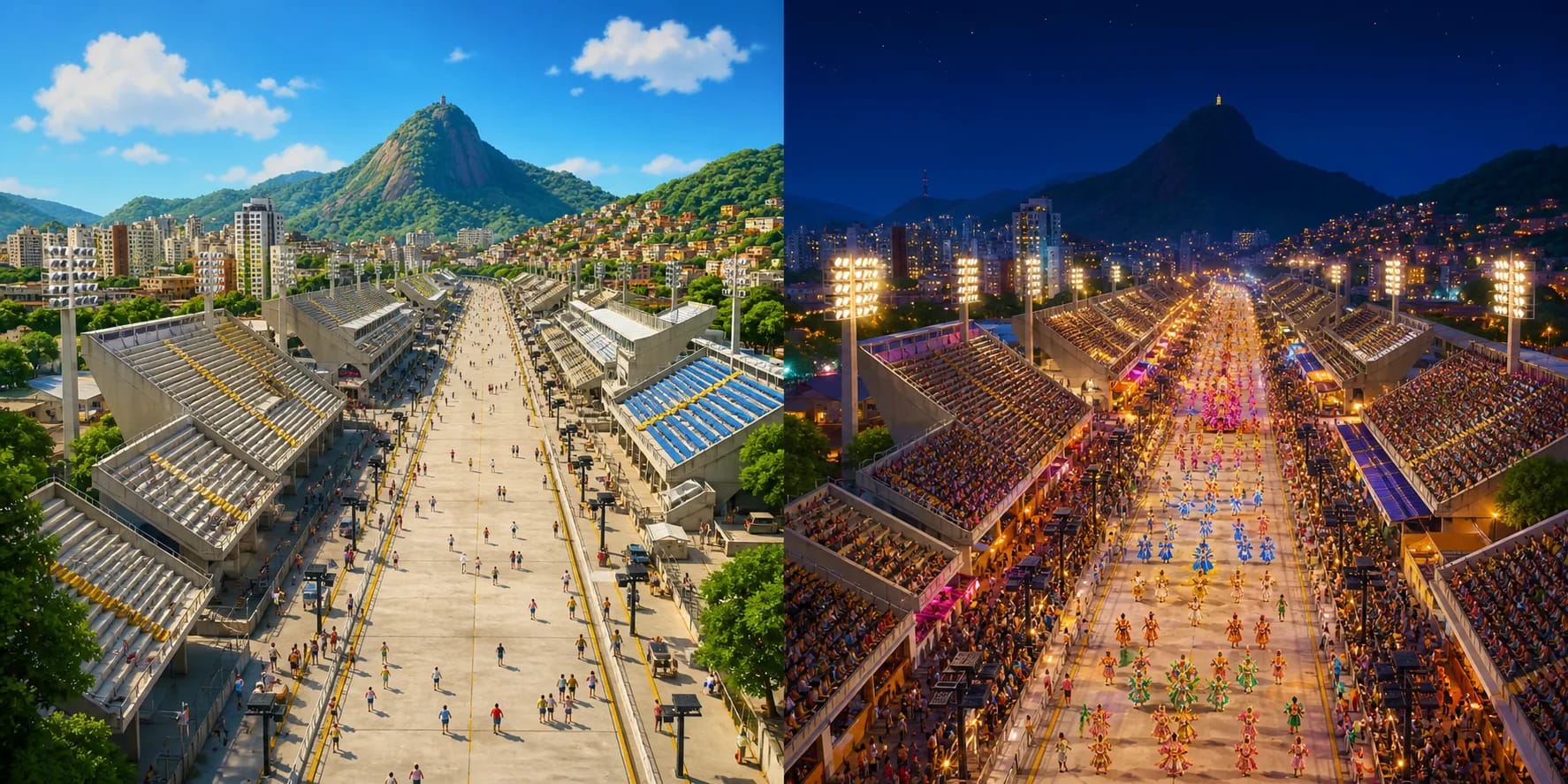
The Sambadrome, designed by Oscar Niemeyer and opened in 1984, is a parade avenue with grandstands on both sides. Since 2025, Special Group schools have paraded across three nights, Sunday through Tuesday; confirm the division and times in that year's official schedule.
It is a judged competition, scored on categories including percussion, harmony, theme, floats and the opening commission. Results come out the following Wednesday, and the Champions' Parade on the Saturday after brings back the best-placed schools. Access-group schools parade on other nights, with cheaper tickets and a much emptier venue.
- Sunday through Tuesday: Special Group parades under the format used since 2025.
- The following Saturday: Champions' Parade.
- Each night runs for many hours and ends near dawn.
Sectors, tickets and what each one gives you
Grandstands are numbered by sector along the avenue, and the experience changes considerably with position. Central sectors give the most complete view of a parade; sectors near the start catch schools still organising themselves; sectors at the end catch them already tired. Some sectors are traditionally more popular with international visitors.
Besides grandstands there are frisas — boxes at the edge of the runway — trackside chairs and hospitality suites with service included, at wildly different price levels. Sales run through official channels and authorised operators, and informal resale is a real problem: buying from unaccredited third parties is the most common source of an invalid ticket.
Street blocos: the free festival
Street blocos are open, free processions spread across practically every neighbourhood. Some pull enormous crowds through the centre and the south zone; others are small and local, with a neighbourhood crowd and a family feel. The calendar starts weeks before the official holiday and continues on the following weekends.
Traditional blocos such as Cordão da Bola Preta in the centre, and processions in Santa Teresa, Botafogo, Ipanema and Laranjeiras, appear every year — but times, meeting points and routes change and depend on permits. The official programme is only confirmed close to the date: use the city hall and Riotur calendars rather than lists from previous years.
What to plan far in advance
Accommodation and flights are the bottleneck. Prices in Rio during Carnival rise sharply and availability disappears months ahead, especially in the south zone and the centre. Many places impose a multi-night minimum stay for the period. Booking months in advance is not excessive; it is how the market normally works.
Carnival dates move every year because they depend on Easter: the holiday falls between early February and early March. Before buying anything, confirm the calendar for that specific year, and remember the city operates on an extended-holiday footing, with shops, museums and services on reduced hours.
How to survive the festival well
Large blocos mean heat, crowds and very little access to a toilet. Plenty of water, sunscreen, a hat, light clothing, closed shoes and the absolute minimum in your pockets is the standard kit. Carry ID and a limited amount of cash, use a zipped bum bag, and leave your passport and spare cards at your accommodation.
Transport changes during Carnival: streets are closed, bus routes divert and the metro usually runs extended hours on specific days, with its own access rules at stations near big blocos. Agree a meeting point with your group, because phone signal drops in crowds — the most common and most predictable problem of the whole festival.
Before buying: date, sector, seat and ticket delivery
Write down the parade date, competition group, sector and seating category before comparing offers. A hospitality package and a grandstand ticket are not equivalent, even on the same night. Check whether seating is allocated, what is included and how the ticket will reach you. Follow the organiser’s current sales links rather than an advertisement that merely uses official-looking graphics.
For a group, agree the same night and sector before anyone pays. Ask about entry requirements, identification, age rules and access needs for that particular product. Save the purchase confirmation and the relevant entrance instructions. Add transport and the following morning’s rest to the cost of a late parade.
Choose one bloco and leave room to recover
Pick a bloco by its music, location, timing and expected format, not only by fame. A family-oriented event, a stationary performance and a moving procession make different demands on the group. Confirm the year on the listing: registration announcements for 2027 are not a final authorised street schedule.
Keep an exit option and a meeting place outside the main crowd. Do not stack several distant blocos into one day or put a demanding hike after an overnight parade. Choose a nearby meal and a flexible next morning; keeping some of the trip unbooked makes changes easier.
Frequently asked questions
- When is Carnival in Rio de Janeiro?
The date changes every year because it depends on Easter, falling between early February and early March. Since 2025, Special Group parades have run Sunday through Tuesday, with the Champions' Parade the following Saturday; confirm the year's schedule.
- How much does it cost to watch the Sambadrome parade?
It varies enormously by sector and seat type: popular grandstands and access-group nights cost a fraction of boxes and hospitality suites. Buy only through official channels or accredited operators — informal resale is the most common cause of trouble at the gate.
- Are Rio Carnival street blocos free?
Yes, street blocos are open and free, spread across the whole city, and the season starts weeks before the official holiday. Routes and times depend on permits and are only confirmed close to the date.
- Does a Sambadrome ticket also include street blocos?
They are separate experiences. A Sambadrome booking covers the date and product purchased; official street blocos generally do not require that ticket. Private Carnival parties may charge separately. Read the organiser’s description for the specific event.
Sources to check before you go
Opening hours, events and visiting conditions change. These are the official references used when reviewing this guide.