A free editorial guide from riodejaneiro.app. Use it to build your itinerary; Rio Pulse’s personalised plans are still in development.
Hillside, yellow tram and white arches
Santa Teresa and Lapa: the tram, the Selarón Steps and bohemian Rio
Santa Teresa and Lapa are glued together on the map and centuries apart in mood. One is a hillside neighbourhood of mansions, studios and a tram that has survived since the nineteenth century. The other is the bottom of the slope, with arches, samba and streets that only wake after dinner. They belong in the same day — in the right order.
Quick answer
Go up to Santa Teresa in the morning or after lunch, ride the historic tram from the centre, walk between Largo do Guimarães and Largo das Neves, visit the Museu da Chácara do Céu, then come down the Escadaria Selarón into Lapa. Leave the Arches and the samba venues for after dark, with a confirmed programme and your route home decided.
The Santa Teresa tram
The yellow Santa Teresa tram is the last survivor of a system that once covered the city, running since the nineteenth century. It leaves from a station in the centre, crosses the Lapa Arches along the top — the colonial aqueduct converted into a rail viaduct — and climbs the hill through narrow cobbled streets.
After a serious accident in 2011 the system was rebuilt with new rules: limited seating, compulsory seat belts and a ban on riding hanging from the running board, an image that still circulates in old photographs. It runs to set hours and can be suspended for maintenance, so confirm before relying on it as transport.
What to see in Santa Teresa
The neighbourhood organises itself around two squares. Largo do Guimarães concentrates restaurants, bars and the flow of visitors; Largo das Neves is smaller, more residential and good for a pause without the crowd. Between them, Rua Almirante Alexandrino strings together mansions, studios, craft shops and guesthouses in old buildings.
The Museu da Chácara do Céu holds a collection of Brazilian and European art in a modernist house with views over the centre and the bay, next door to the Parque das Ruínas — the preserved shell of a mansion turned into a public viewpoint and cultural centre. The two are metres apart and make the most efficient cultural stop in the neighbourhood.
- Largo do Guimarães: food, bars and the meeting point.
- Parque das Ruínas: free viewpoint over the centre.
- Museu da Chácara do Céu: art and a view at one address.
The Escadaria Selarón
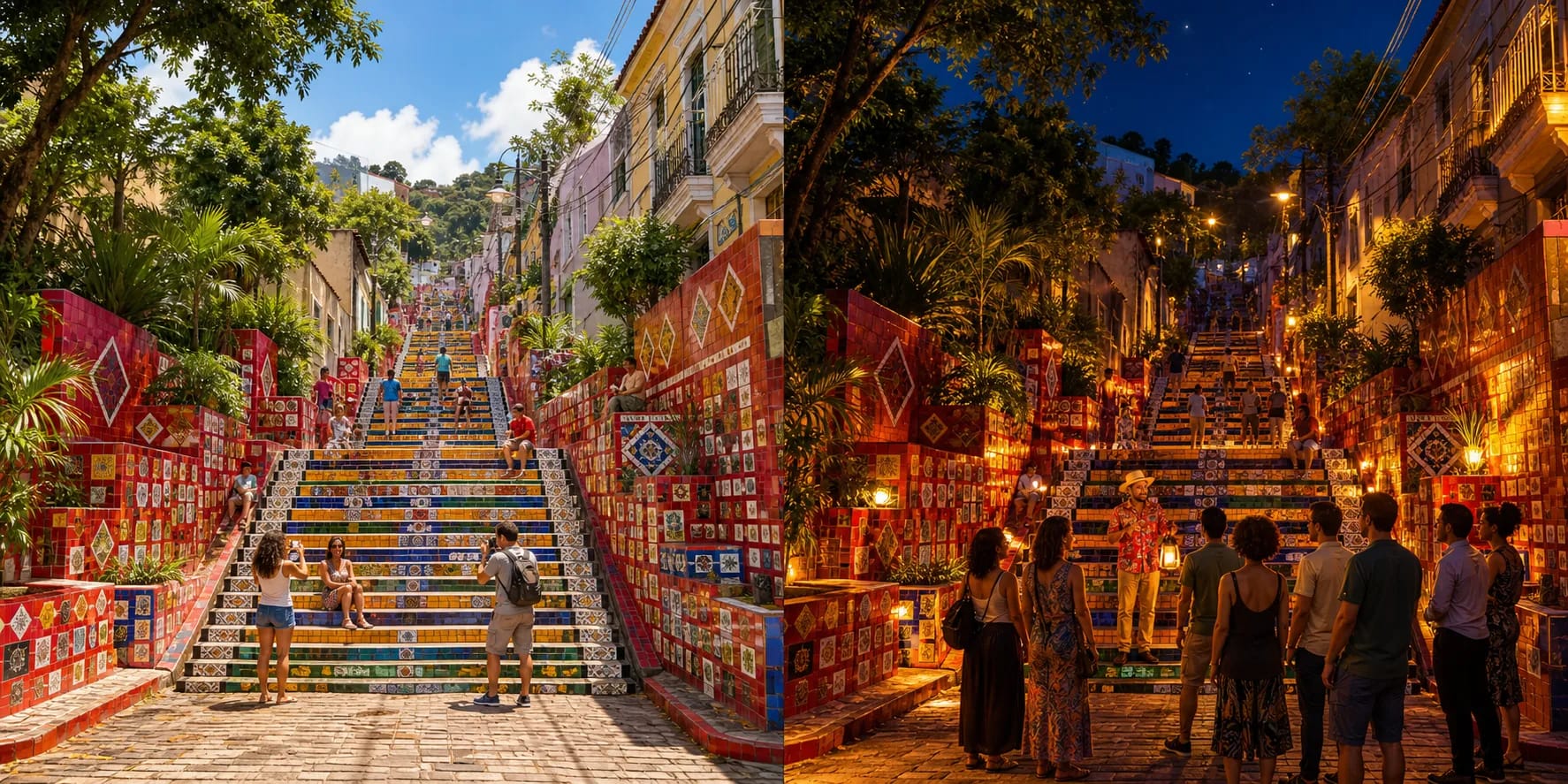
The Escadaria Selarón links Lapa to Santa Teresa across 215 steps covered in tiles from more than fifty countries. The Chilean artist Jorge Selarón began the work in 1990 as an intervention on the staircase outside his house and kept at it until his death in 2013. It is a living work of public art, now protected, rather than a simple photo stop.
The staircase is open at all times but works best in the morning, when the light helps and there are fewer people. It is steep and narrow in places; avoid climbing it alone at night. The natural direction is downhill from Santa Teresa into Lapa, which saves your legs and ends the walk at street level.
Lapa: the Arches and the night
The Lapa Arches are the old Carioca Aqueduct, built in the eighteenth century to bring water from the Tijuca Forest down to the centre. Today they carry the tram and anchor the district visually. Around them, music venues, bars and clubs form the city's densest concentration of live music.
Lapa changes character by hour and by weekday. In daylight it is a thoroughfare, with traffic and ordinary shops; on weekend nights the streets fill. If the point of the trip is samba or a show, choose the venue and confirm the official programme before setting out — arriving without a plan produces more wasted time than discovery.
Fitting both into the itinerary
The order that works is top-down: go up to Santa Teresa by tram, app, or by metro to Glória followed by a short climb, walk the neighbourhood, and descend via the Selarón Steps. Doing it the other way means facing steep gradients in full sun, and Santa Teresa punishes anyone who improvises on foot.
At night, treat the two areas separately. Santa Teresa has restaurants that work well for dinner, with app-based transport. Lapa concentrates the nightlife; there it is worth staying on the busy streets, keeping your phone away and deciding your exit point before going into any venue.
How to plan Santa Teresa if the tram is unavailable
Treat the tram as an experience with its own operating rules, not as the only way to make the day work. Before leaving, identify your first destination in Santa Teresa and an alternative arrival by licensed transport. Ask the venue where to be dropped off: a nearby point on a map can still involve a steep climb.
Keep the visit around a small cluster, such as a museum and lunch, instead of following every winding street. If steps or cobbles are a problem, ask about the precise entrance and return pickup point. The neighbourhood guide explains why elevation matters when choosing an address.
A daytime visit and a night out need different plans
For daylight sightseeing, prioritise the buildings, views and tiled staircase, with an agreed endpoint. Do not assume a route that worked in daylight is the right way home after a concert. If music is the priority, choose the venue and its actual programme before travelling to Lapa.
Check the event’s start time, admission format and how you will leave. There is no need to keep walking for hours between an afternoon visit and a late show: returning to your accommodation can be the more comfortable choice. See the nightlife guide for planning the evening separately.
Frequently asked questions
- Is the Santa Teresa tram running?
The tram returned to service after the system was rebuilt, with limited seating and compulsory seat belts, departing from a station in the centre. It runs to set hours and can be interrupted for maintenance, so check an official source on the day.
- Is the Escadaria Selarón safe to visit?
During the day, with a steady flow of visitors, it is an ordinary and straightforward visit with the usual urban precautions. At night the surrounding area empties in places; prefer company and avoid displaying expensive equipment.
- Can you do Santa Teresa and Lapa in the same day?
Yes, and it is the most efficient plan. Do Santa Teresa in daylight, come down the Escadaria Selarón, and leave Lapa for the early evening with the venue's programme already confirmed.
- Can I take a pushchair or wheelchair along the full Santa Teresa–Selarón route?
Do not assume the full route is step-free: it involves hills, uneven surfaces and a staircase. Plan individual accessible stops with each venue and transport provider instead of relying on the walking itinerary as a continuous accessible route.
Sources to check before you go
Opening hours, events and visiting conditions change. These are the official references used when reviewing this guide.