A free editorial guide from riodejaneiro.app. Use it to build your itinerary; Rio Pulse’s personalised plans are still in development.
Long beaches, wide avenues and a different Rio
Barra da Tijuca and Recreio: beaches, surf, parks and when to stay there
Barra da Tijuca and Recreio dos Bandeirantes are Rio's newer, flatter and more spread-out west-side neighbourhoods: long open beaches, gated condominiums, big malls and multi-lane avenues. They suit some trips very well and others badly. This guide explains what is there, how the area actually works on the ground and who should base themselves there.
Quick answer
Barra da Tijuca and Recreio are beach neighbourhoods west of the south zone, with the city’s longest stretch of open sand, good surf and kitesurf, and access to wilder beaches such as Prainha and Grumari. Metro Line 4 reaches Jardim Oceânico at Barra’s eastern end; beyond that you depend on BRT, buses, app rides or a car. Stay there for surfing, families or events, not for first-time sightseeing.
What Barra and Recreio actually are
Barra da Tijuca sits on a long sandbar between the Atlantic and a chain of lagoons, west of São Conrado and the Tijuca massif. It grew mostly from the 1970s onwards, planned around cars rather than streets, so it looks nothing like Copacabana or Ipanema: towers set back behind walls, shopping centres, wide avenues such as Avenida das Américas and Avenida Lúcio Costa along the sea, and long distances between everything. Recreio dos Bandeirantes continues the same shoreline further west and feels lower, quieter and more residential.
For a visitor, the useful mental map is a line running east to west. Jardim Oceânico, next to the canal and the metro station, is the most walkable pocket, with bars, restaurants and the Line 4 terminus. The middle of Barra is condominiums and malls. The Reserva stretch is almost empty coastline. Recreio ends at Pedra do Pontal, and beyond it the road climbs to Prainha and Grumari. If you have read our overview of Rio’s neighbourhoods, this is the part that works least like the rest.
The beaches: Barra, Reserva and Recreio
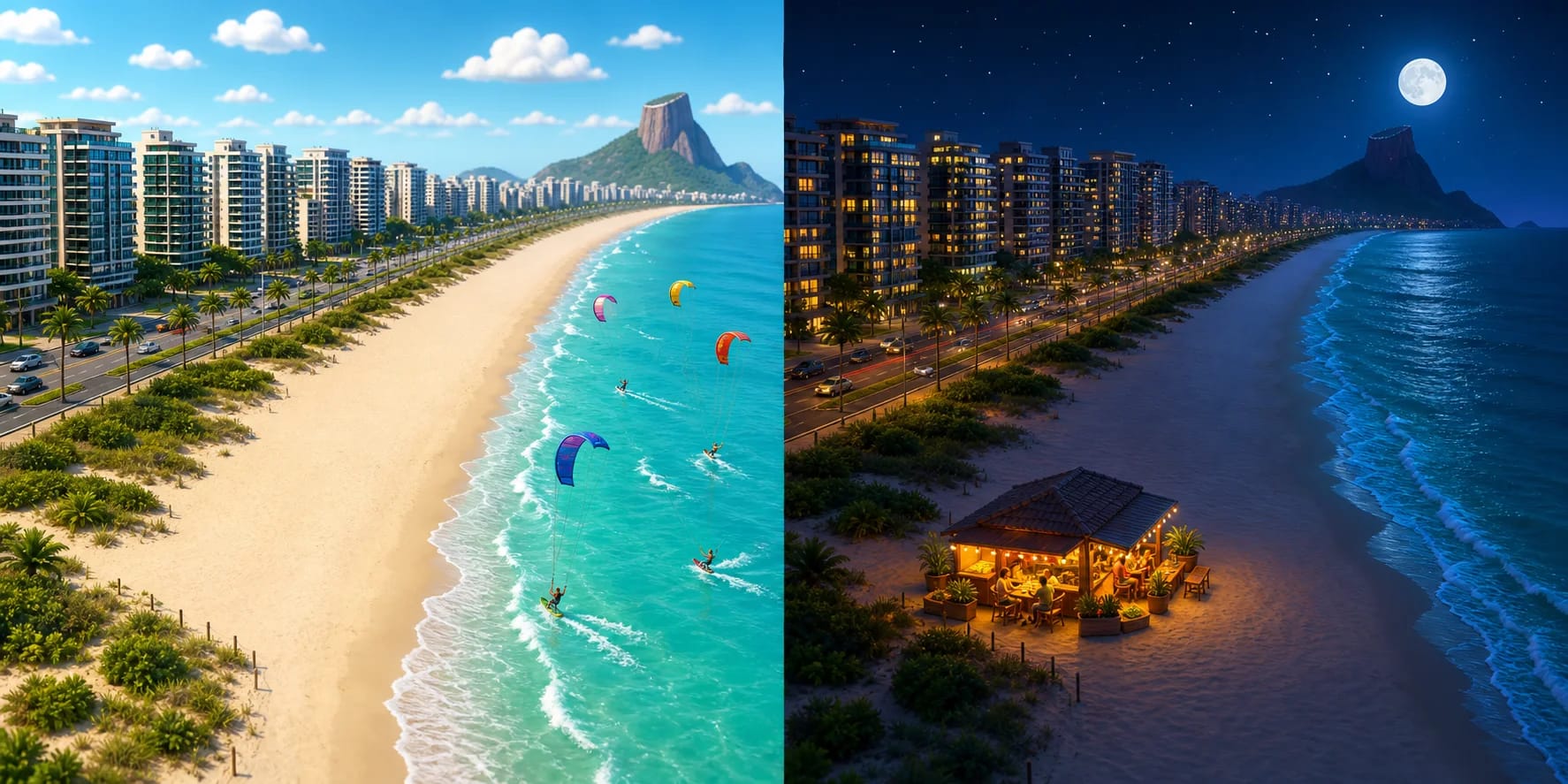
The Barra beach is the longest continuous stretch of sand in the city, often described as around 18 kilometres when Reserva is included. It is wider, cleaner-looking and far less crowded than the south zone beaches, with kiosks along the promenade and plenty of space even at weekends. The flip side is exposure: the open Atlantic brings stronger waves and currents than the bay-facing beaches, and shade is scarce. Swim near lifeguard posts, respect the flags and ask the lifeguards when in doubt.
Reserva, between Barra and Recreio, is backed by the Marapendi natural park, so there are almost no buildings and few services; bring water and plan for longer walks to a kiosk. Recreio beach is a favourite with local families and surfers, calmer in feel than the middle of Barra. Water quality varies with rain and sewage runoff across the whole city, so check the current bathing bulletins from the state environment agency before swimming, as you would for any of the best beaches in Rio.
- Jardim Oceânico end: closest to the metro, busiest, most bars nearby.
- Central Barra: wide sand, kiosks, lifeguard posts, little shade.
- Reserva: nearly undeveloped, few services, bring supplies.
- Recreio: family and surf atmosphere, ends at Pedra do Pontal.
Pedra do Pontal, Prainha and Grumari
Pedra do Pontal is the rocky headland at the western end of Recreio, with a short, steep path to a lookout over the whole Barra coastline. It is a good late-afternoon walk, but the rock can be slippery after rain; wear proper shoes and go with daylight to spare. Just past it, Praia da Macumba is a local surf beach, and from there the coastal road rises towards the protected beaches that many cariocas consider the most beautiful in the city.
Prainha is a small beach of about 700 metres inside a municipal natural park, surrounded by Atlantic Forest and known for consistent surf. Grumari, a little further, is longer and wilder, with restinga vegetation and very limited development. Both are protected areas with their own rules and park hours, public transport is thin and parking fills early at weekends in summer, so most visitors come by car or app ride and leave before dark. Check current access notices with the municipal environment department before going, and bring water, sun protection and cash or a card for the few kiosks.
Surf, kitesurf and sea conditions
The west side is where Rio’s surfing concentrates. Open-ocean exposure means Barra, Recreio, Macumba and Prainha pick up swells that barely reach the bay, and there are surf schools and board rentals along the shoreline. Beginners usually start with lessons on the gentler days in Barra or Recreio; Prainha is better suited to people who already surf, as it can get crowded and powerful. Our surfing guide covers spots, seasons and etiquette in more detail.
On windy afternoons, kitesurfers and windsurfers use stretches of Barra and the lagoons behind it, and several schools offer courses. Wind, swell and water quality change daily, so treat any fixed rule of thumb with caution: check the forecast, ask a school which area they are using that day and never go out alone on an unfamiliar beach. If you are not a surfer, simply watching from the promenade at Recreio at sunset is one of the area’s pleasures.
Bosque da Barra, Parque Olímpico and Cidade das Artes
Bosque da Barra is a municipal natural park on Avenida das Américas that protects restinga, the sandy coastal vegetation that once covered this whole plain. It has walking circuits, a lake, lawns and playgrounds, which makes it an easy half-day for families. Further inland, the Parque Olímpico built for the 2016 Games now hosts concerts, sports events and public open space, and the Rio Olympic Museum opened in the Velodrome in 2025. Check opening days and event closures before going, especially if you are coming with children.
Cidade das Artes, the concrete complex with sail-like walls designed by Christian de Portzamparc, is the area’s main cultural venue, with a large concert hall, theatres and a public library. Look at its programme before planning a visit around it. The rest of Barra’s leisure life happens in malls such as BarraShopping and Village Mall, which work as air-conditioned refuges on very hot or rainy days, and around Jardim Oceânico, where most of the independent bars and restaurants are.
Metro Line 4, BRT and the car question
Metro Line 4 ends at Jardim Oceânico, at Barra’s eastern tip, and runs through São Conrado and Leblon to Ipanema, where it links with Line 1 towards Copacabana and the centre. If you stay within walking distance of that station, reaching the south zone is straightforward. From there westwards, the BRT bus corridors take over: TransOeste runs along Avenida das Américas towards Recreio, and other corridors connect to the Olympic Park and, via TransCarioca, to Galeão airport. Check routes on the metro map and current service information from the operators.
In practice, much of Barra and Recreio is built for cars. Blocks are long, crossings on the big avenues are few and far apart, and many hotels sit on stretches where walking to dinner is not realistic. App rides are widely used, but journey times swing heavily with traffic, particularly at rush hour and on summer weekends. Our getting around guide explains fares and cards; here, the key point is to budget time generously for every trip east.
- Jardim Oceânico: Line 4 terminus, the easy link to the south zone.
- BRT TransOeste: along Avenida das Américas towards Recreio.
- Beyond Recreio: Prainha and Grumari are best reached by car.
When staying in Barra makes sense (and when it doesn’t)
Barra and Recreio are a sensible base if your trip is built around them. Families often like the larger apartments, condominium pools and quieter beaches. Surfers gain easy daily access to the best breaks. Anyone attending events at Riocentro, the Olympic Park or big festivals such as Rock in Rio, held at the Cidade do Rock next to the Olympic Park, saves long evening journeys by staying nearby. Longer stays with a rental car can also work well.
For a first visit focused on sightseeing, it is usually the wrong choice. Christ the Redeemer, Sugarloaf, Santa Teresa, the centre and the classic beaches are all in the south and central zones, and every day would start and end with a long transfer. If you want Barra’s beaches without the commute, a compromise is to stay in Ipanema or Leblon and take Line 4 out for a day, or split the trip between both areas.
- Good fit: families, surfers, events at Riocentro or the Olympic Park.
- Workable: long stays with a car, remote workers wanting space.
- Poor fit: short first trips centred on the main landmarks.
Frequently asked questions
- Is Barra da Tijuca a good area to stay in Rio?
It depends on the trip. Barra suits families, surfers and people attending events at Riocentro or the Olympic Park. For a short first visit focused on landmarks, the south zone is usually more practical, because most sights are there and Barra involves long transfers.
- How far is Barra da Tijuca from Copacabana?
Distance varies a lot within Barra. From Jardim Oceânico, Metro Line 4 connects to Ipanema and on to Copacabana, making it the easiest link. From central Barra or Recreio you add a BRT, bus or car leg, and road journeys can take much longer in traffic.
- Can you reach Barra da Tijuca by metro?
Yes, but only its eastern end. Line 4 terminates at Jardim Oceânico. From there, BRT corridors and buses run west along Avenida das Américas towards Recreio. Check current routes and service notices with the operators before relying on a connection.
- What is there to do in Recreio dos Bandeirantes?
Mainly beach and outdoor life: surfing, the sunset walk to Pedra do Pontal, Praia da Macumba and trips to the protected beaches of Prainha and Grumari. Recreio is residential and quiet, so evenings are low-key compared with the south zone.
- Is it safe to swim at Barra da Tijuca beach?
Barra faces the open Atlantic, so waves and currents can be strong. Swim near lifeguard posts, follow the flags and ask lifeguards about conditions. Water quality also changes with rain, so check the current bathing bulletins before going in.
Sources to check before you go
Opening hours, events and visiting conditions change. These are the official references used when reviewing this guide.